14 min read – Last update: November 20, 2026
If there is one place in the world where you can turn a vacation into a complete beauty reset, it is Seoul.
But where should you actually start? Which Korean beauty treatments are worth trying? What happens inside a skin clinic? Is a personal color analysis really useful? What should you buy at Olive Young? And how much of what you see on TikTok is actually worth your money?
After spending around two and a half years in Korea and making beauty, skincare and self-care a big part of my life here, I created this guide to explain the world of K-Beauty beyond the viral products. From skincare and dermatology to hair, nails, lashes, dental treatments, body treatments and plastic surgery, this is your introduction to planning a complete Seoul glow-up.
Hi, I’m Audrey.
I’m a professional travel consultant. Over the past 4 years, I’ve explored 50+ countries as a solo female traveler. Through my firsthand experience, local connections, and professional partnerships, I create 100% personalized trips designed around you, your interests, and your travel style, with zero stress.
My goal is simple: to turn your dream trip into reality.
Whether it’s South Korea or any other destination, click below, fill out the questionnaire and let me help you.
You notice Korea’s relationship with beauty very quickly after arriving in Seoul.
Skincare shops are everywhere. Dermatology clinics occupy entire floors of buildings. Hair salons offer scalp analysis alongside cuts and colors. Personal color studios can tell you which shade of lipstick, jewelry and hair color works best with your skin. Cosmetic procedures that might feel like a major event somewhere else can be treated almost like another appointment in your monthly routine.
Part of this comes from innovation. Korea has built an enormous beauty industry around prevention, skincare, technology and constant product development. Dermatology and plastic surgery are also major parts of Korean medical tourism, and competition between clinics helps create a huge range of treatments and price points.
One of the biggest advantages is price.
Many treatments that can be extremely expensive in the United States, Australia or major European cities are much more accessible in Korea. You can find advanced laser treatments, facials, skin boosters, hair treatments and other beauty services at prices that can feel surprisingly low if you are used to Western beauty markets.
But there is another side of Korean beauty culture that I don’t think should be romanticized.
Appearance can carry a lot of social weight in Korea. There is even a commonly discussed word, 외모지상주의 — oemojisangjuui, usually translated as lookism: placing excessive importance on appearance or treating people differently according to the way they look.
The pressure can become exhausting.
Skin needs to be clearer, faces smaller, bodies slimmer, noses higher, eyes bigger, hair shinier. Once every tiny imperfection becomes something that can theoretically be corrected, self-care can very easily turn into constantly searching for the next thing that is “wrong.”
And that is the part I don’t like.
What I do love is the other side of Korean beauty culture: taking care of yourself. Spending time on your skin. Learning what colors suit you. Looking after your scalp instead of waiting until your hair becomes damaged. Having access to professionals and technology that would be much more expensive or difficult to find elsewhere.
My philosophy is simple:
Take the innovation, take the self-care and leave the pressure behind.
I’ve spent around two and a half years in Korea, and beauty has naturally become one of the parts of the country I know best.
I’m genuinely obsessed with skincare and self-care, I regularly create beauty content for my social media, and over the years I’ve visited more than 30 Korean aesthetic clinics, both through collaborations and with my own money.
I’ve also tried different dentists, hair salons, skincare products and beauty experiences until I found the people and places I personally trust.
I now have my favorite skin clinics depending on the treatment I need, my trusted dentist, my favorite hairstylist and the beauty services I would personally book again.
And this is important because after trying so many places, I’ve learned that the most viral clinic is not automatically the best clinic, the most expensive option is not necessarily the best one and the cheapest promotion is definitely not always the smartest choice.
There are an almost ridiculous number of things you can do in Seoul.
Some are genuinely amazing. Some are overhyped. Some are completely unnecessary.
So instead of overwhelming you with hundreds of names, let’s start with what is actually available and what each experience is for.
If you’re planning to change your hair or buy a suitcase full of Korean makeup, I would actually do your personal color analysis first.
Korean personal color analysis goes much further than somebody looking at you and declaring that you are “warm” or “cool.”
During a proper consultation, different fabric swatches are placed around your face to see how colors affect your complexion. Your analyst may also look at undertone, contrast, jewelry, makeup shades and hair colors.
Most systems eventually place you somewhere within Spring, Summer, Autumn or Winter, usually with more specific subcategories.
One of the things I find most interesting about it is how obvious certain differences become when the colors are physically next to your face. A shade can suddenly make your skin look brighter and more even, while another can exaggerate shadows or redness.
Some sessions also analyze the makeup you already own, so bring your makeup bag if you want to know which products actually suit you.
A personal analysis in Seoul can cost roughly around ₩70,000–₩120,000, depending on how detailed the session is.
My favorite order is simple:
Color analysis first, hair afterwards, makeup shopping last.
There is very little sense in buying 6 new lip tints and then discovering the following morning that none of them are in your best palette.
Haircare in Korea is another rabbit hole.
You can obviously book a normal haircut, blow-dry or color, but Korean salons also offer treatments focused on volume, texture, scalp condition and repairing damage.
If you want the classic Korean look, you will hear about digital perms and setting perms, which can create soft waves rather than a traditional tight perm.
Root perms are another very Korean salon service. Instead of curling the entire hair, the treatment gives lift around the roots so the hair doesn’t sit flat against the scalp.
For damaged hair, salons may offer protein treatments, moisture treatments, keratin services and bond-repair treatments, particularly after bleaching or frequent coloring.
Korean haircare also tends to treat the scalp almost like an extension of facial skincare, with much more attention paid to buildup, dryness, oil production and scalp health than many travelers are used to.
I tried several salons before finding the hairstylist I now trust in Korea.
Once you find someone who understands your face, your hair texture and the exact style you want, you don’t let them go.
This is one of the beauty experiences I would recommend even to someone who doesn’t care about aesthetic treatments.
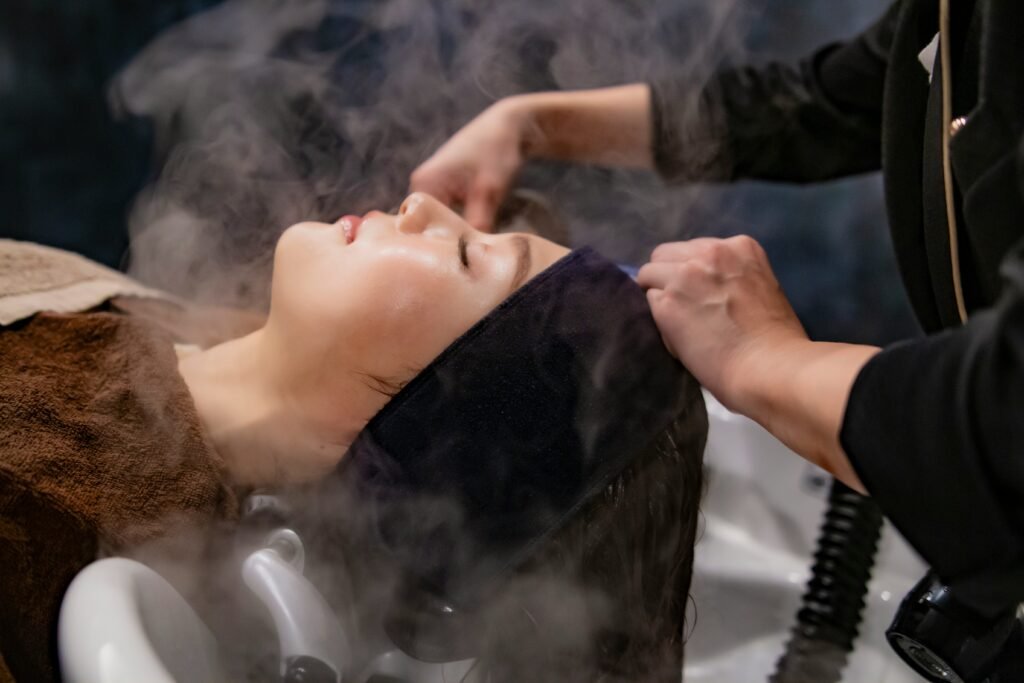
A Korean head spa normally begins with an extremely close-up scalp analysis.
Be prepared: seeing your scalp magnified on a screen is strangely horrifying and fascinating at the same time.
Depending on the program, the treatment can include scalp exfoliation or scaling, massage, cleansing, steaming, shampoo, conditioning, hair repair and another analysis at the end.
Some salons advertise programs with 15 or even 18 different steps.
Personally, I wouldn’t obsess over the number.
Fifteen steps don’t automatically make a treatment better than 8. What matters is whether the treatment actually suits your scalp and hair.
The reason I still love the experience is that it sits perfectly between beauty treatment and spa day.
Not every glow-up requires a machine or a doctor.
Korea is incredible for nail art.
You will see everything from simple syrup and jelly nails to chrome, magnetic designs, tiny hand-painted details and elaborate 3D sets.
Many salons also create monthly sets with pre-designed options, which makes choosing much easier if you don’t speak Korean.
Just remember that prices may change depending on removal, extensions and additional art.
For your eyes, lash perms or lash lifts are extremely common.
They are one of my favorite examples of a small treatment making a surprisingly big difference, particularly if your natural lashes grow straight down.
Extensions, lash tinting and different curl styles are also widely available.
Brows can be shaped, tinted or laminated, while semi-permanent brow treatments are another option if you want something longer lasting.
These are the kinds of appointments I would personally leave relatively late in the trip because they create an immediate finished look without days of swelling or recovery.
Book a one-on-one consultation with me and get personalized advice based on your needs. Let’s talk.
This is the part of Seoul beauty that overwhelms most foreigners.
You open a clinic menu and suddenly see 40 different lasers, 10 boosters and machines you’ve never heard of.
The first thing to understand is that there is no single “best Korean treatment.”
The treatment should depend on the problem.
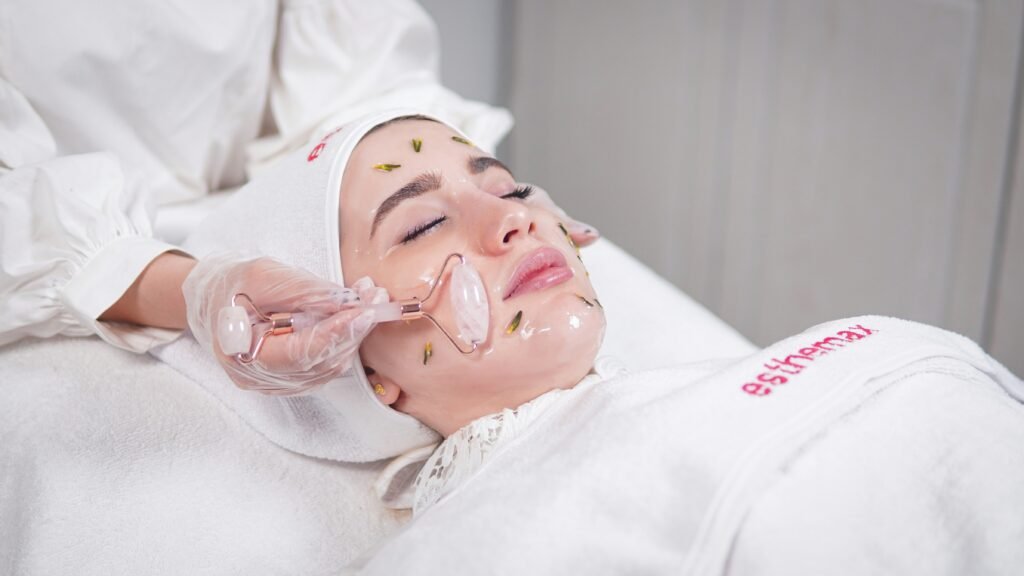
If your main concern is congestion and you want something gentle with minimal downtime, you may be offered an Aqua Peel or hydro-style cleansing facial.
If you struggle with pigmentation, clinics may discuss laser toning or pico treatments.
Texture and acne scarring can involve microneedling, RF microneedling or fractional lasers, depending on your skin and the severity of the problem.
You may also see treatments for redness, enlarged pores, uneven tone and collagen stimulation.
This is exactly why I would never walk into a clinic simply saying:
“I saw this on TikTok, give it to me.”
Tell them what bothers you first.
Skin boosters are one of the things that made Korean dermatology famous internationally.
Rather than changing the shape of your face like a traditional filler, the goal is usually to improve the quality, hydration, texture or overall appearance of the skin.
One of the names you will hear constantly is Rejuran, which uses polynucleotides.
You may also come across Juvelook, hyaluronic-acid-based boosters, PDRN-related treatments and other collagen-stimulating injectables.
Some can leave tiny bumps across the face immediately afterwards, and bruising or swelling is possible.
This is why treatment timing matters.
If you’re taking beautiful Seoul photos every day, don’t schedule your first injectable treatment 2 hours before a photoshoot.
And please don’t assume that because something is called a “skin booster” it is basically a facial.
It is still a medical procedure.
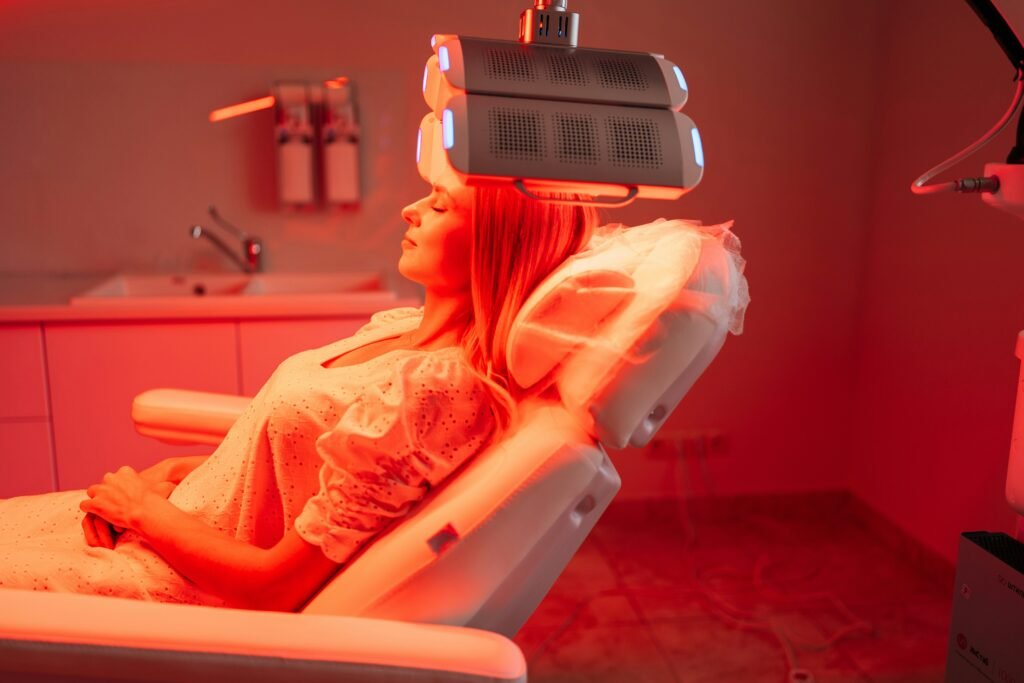
Korean clinics are also famous for combining different machines.
For lifting and tightening, you may hear names such as Ultherapy, Shurink or other HIFU treatments, which use ultrasound energy.
You will also hear about Thermage and other radiofrequency treatments, which work differently.
Then there are treatments such as InMode, RF microneedling and Titanium lifting, depending on whether the goal is tightening, contouring, collagen stimulation or texture.
Clinics sometimes combine several technologies because they target different depths or different concerns.
This can also be much more affordable in Korea than in many Western countries.
But cheaper does not mean you should do more.
One of the biggest mistakes beauty tourists make is treating the clinic menu like an all-you-can-eat buffet.
Your face does not need 8 procedures just because you can afford them.
Botox is also widely available and may be used for expression lines, the masseter area or other indications depending on the patient.
You may also hear about skin Botox, sometimes referred to as micro-Botox or meso-Botox, where small amounts are placed more superficially with a different goal from conventional muscular Botox.
Fillers are offered for areas including lips, chin and other facial contours.
Again, this is where choosing the practitioner matters more than finding the cheapest promotion.
After more than 30 Korean clinics, I can tell you that two clinics offering a treatment with the exact same name can give you completely different experiences.
Consultation quality matters.
The doctor’s technique matters.
Whether they understand what you actually want matters.
The Korean beauty world doesn’t stop at the face.
There are clinics dedicated to body contouring and others focused more broadly on medically supervised weight management.
For localized contouring, you will find fat-freezing treatments, body HIFU, radiofrequency, microwave-based body contouring, muscle-stimulation devices, lymphatic treatments and lipolysis-related procedures.
These are not the same thing as losing a significant amount of weight.
Body-contouring treatments are generally focused on particular areas and body shape rather than replacing nutrition, exercise or medical weight management.
Some clinics also offer body-composition testing, dietary consultations and medical weight-management programs.
Prices vary enormously because treating one small area is completely different from creating a full multi-session body program.
This is one of those categories where a single “Korean price” would honestly not tell you very much.
This is one part of the Korean glow-up that gets ignored in far too many beauty guides.
One of the biggest changes in my own appearance since living in Korea has been my smile.
I’ve visited different dentists here before finding the one I now trust, and cosmetic dentistry became another important part of my personal glow-up.
Depending on your smile, Korean dental clinics can offer professional cleaning, whitening, composite work, cosmetic bonding, veneers, gum contouring, orthodontics and clear aligners.
You absolutely do not need veneers just because you want prettier teeth.
Sometimes professional whitening, cleaning or small conservative changes can make a much bigger difference than you expect.
Dental treatments also need more planning than nails or lashes because you may require multiple visits.
If your smile is an important part of your Seoul glow-up, arrange the consultation early in the trip instead of leaving it for your final afternoon.
And then there is the part Korea is probably most famous for after skincare: plastic surgery.
This could easily become an entire article by itself, so I don’t want to turn this guide into a surgical encyclopedia.
Some of the procedures you will hear about most often include double-eyelid surgery, ptosis correction and other eye procedures, rhinoplasty, V-line and facial-contouring surgery, chin surgery, facelift and neck lift, fat grafting, liposuction and body contouring, breast augmentation, reduction or lift and other body surgeries.
The important distinction is that a beauty trip and a surgery trip are not the same thing.
You can do your nails on Friday night and fly home on Saturday.
You should not treat surgery that way.
Surgery requires proper consultation, medical screening, recovery, post-operative care and a plan for what happens if something isn’t healing as expected.
If surgery is the main reason you’re traveling to Korea, build the trip around the surgery rather than trying to squeeze surgery into a normal Seoul vacation.
If K-Beauty is one of the reasons you are traveling to Korea, I also have several South Korea PDF Travel Guides where I go much deeper into beauty, treatments, shopping, restaurants, neighborhoods and practical travel information.
In this article, I want to give you a complete overview of what is actually possible in Seoul, what is worth knowing before you book anything and how you can build your own Korean glow-up without getting completely overwhelmed by the amount of choice.
Explore my digital travel guides, packed with itineraries, local restaurants and cafés, hidden gems, practical tips, and everything you never even thought you’d need.
Click below, fill out the questionnaire, and I’ll bring your dream trip to life, 100% personalized around you.
Want to discover more about K-SOUL Travel and how I can help you? I’m a Professional Travel Consultant, and I can personally design your entire trip from scratch, creating a fully customized itinerary based on your destination, budget, travel style, and specific needs — including honeymoons, special occasions, solo female travel, and Muslim & Halal-friendly trips. You can also book a private consultation with me, join one of the group trips I personally host, or explore 50+ PDF travel guides. If you found this article helpful and want to support my work, discover K-SOUL Travel — I’d love to help you create your next adventure.
All South Korea travel guides →
Want a trip designed entirely around you? Design your trip with K-SOUL →